The newly-formed UK arm of Entertainment Partners was targeting a private equity sale but only had 3% market share.
The targeted horizon for TPG’s investment in Entertainment Partners was fast approaching. The company had been preparing for a sale by establishing a global footprint in the UK and Australia.
Problem
We needed to gain a bigger market share in the UK, establishing repeat business through a good reputation.
However, our timesheets product was causing delays to payroll and this reputation was holding us back.
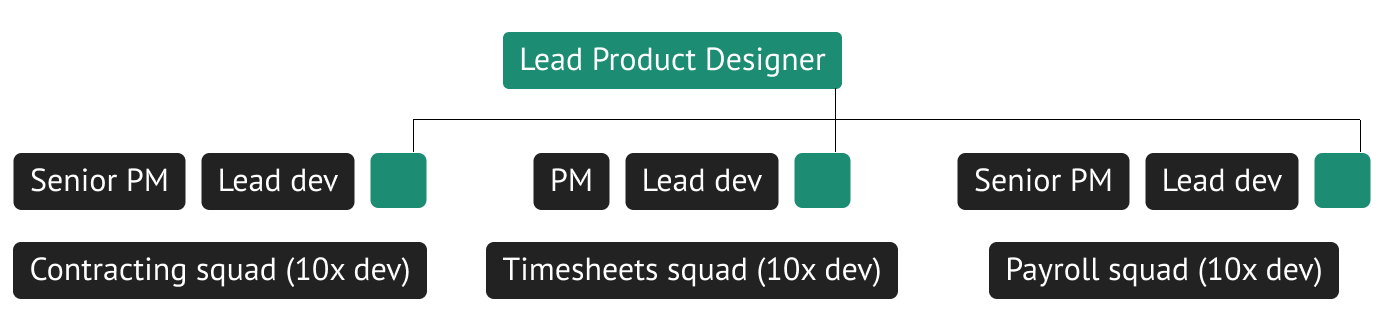
I was the sole designer working across three squads, one of which was dedicated to timesheets.
As the Product Designer, I was responsible for:
Discovery
Interaction design
User testing & design QA
I also wrote the queries and built the Domo dashboards to measure the impact of the design.
Discovery
We conducted more than 30 hours of initial user research, documenting and mapping ~300 user stories across 19 jobs-to-be-done.
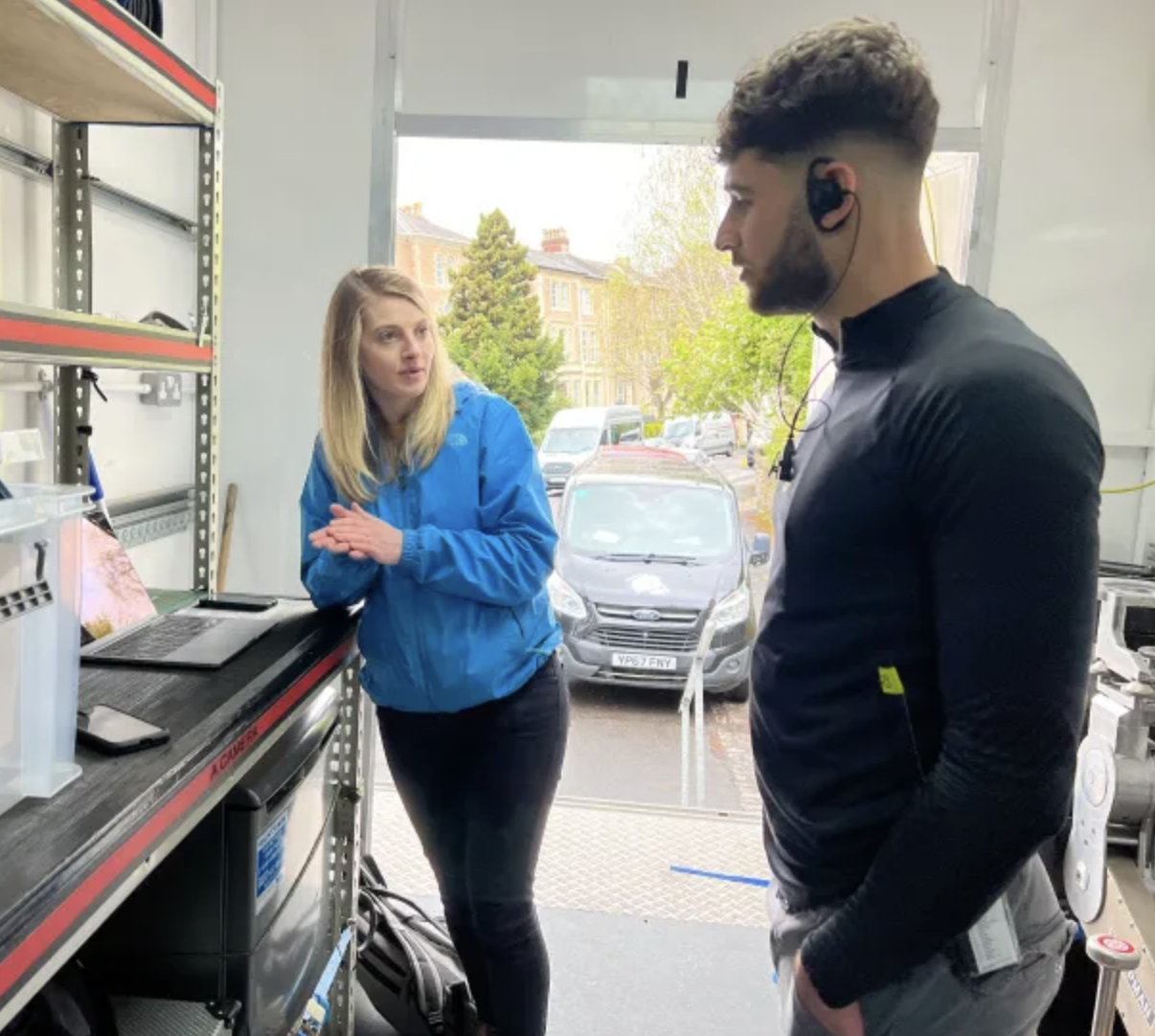
That’s us (pictured) on the set of a production in Bristol.
While there was an initial explicit discovery period, I implemented a discovery process that enabled myself and the project managers to independently conduct research and analysis. This included building a research repository (in Notion) to document our progress and align on our shared findings.
This process was continued for over 12 months as we continued to iterate on the project:
We consolidated and updated the user personas - laying the foundation for the rest of our work
We worked with the development leads to identify the technical constraints affecting each squad
We set up twice-weekly calls with the sales and account management team(s) to gather customer feedback and share updates

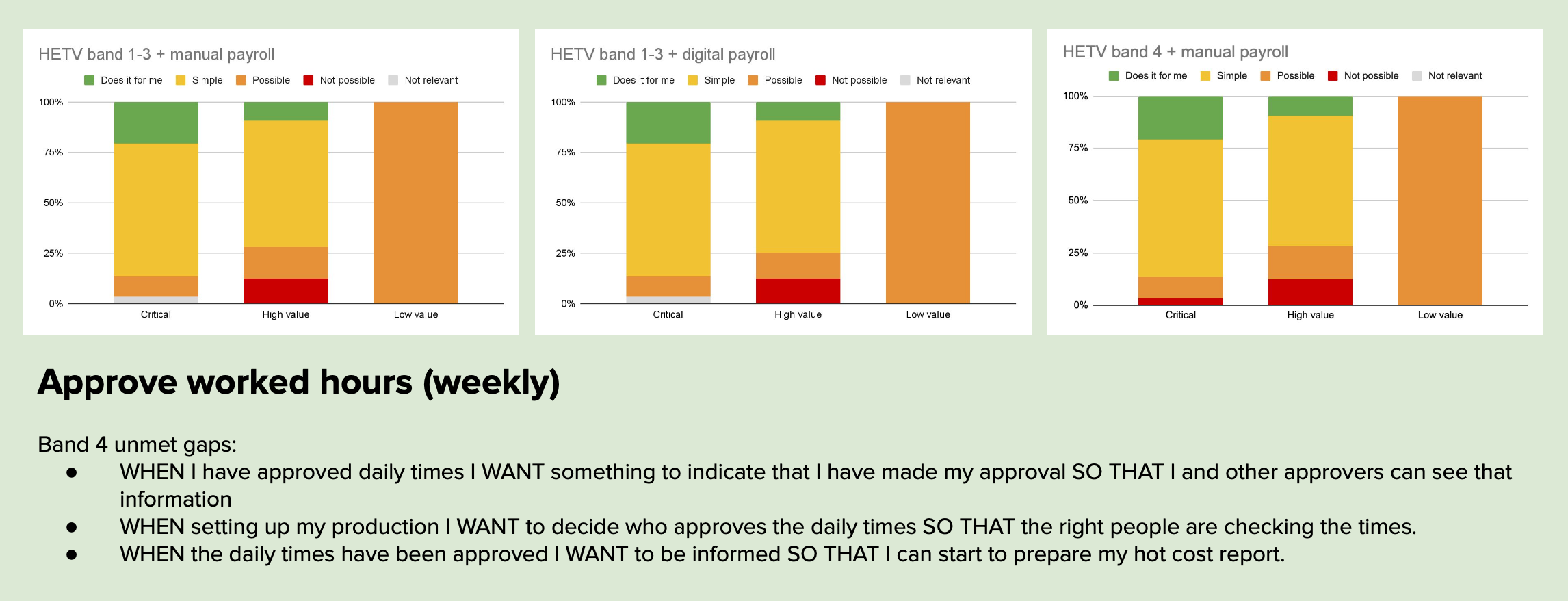
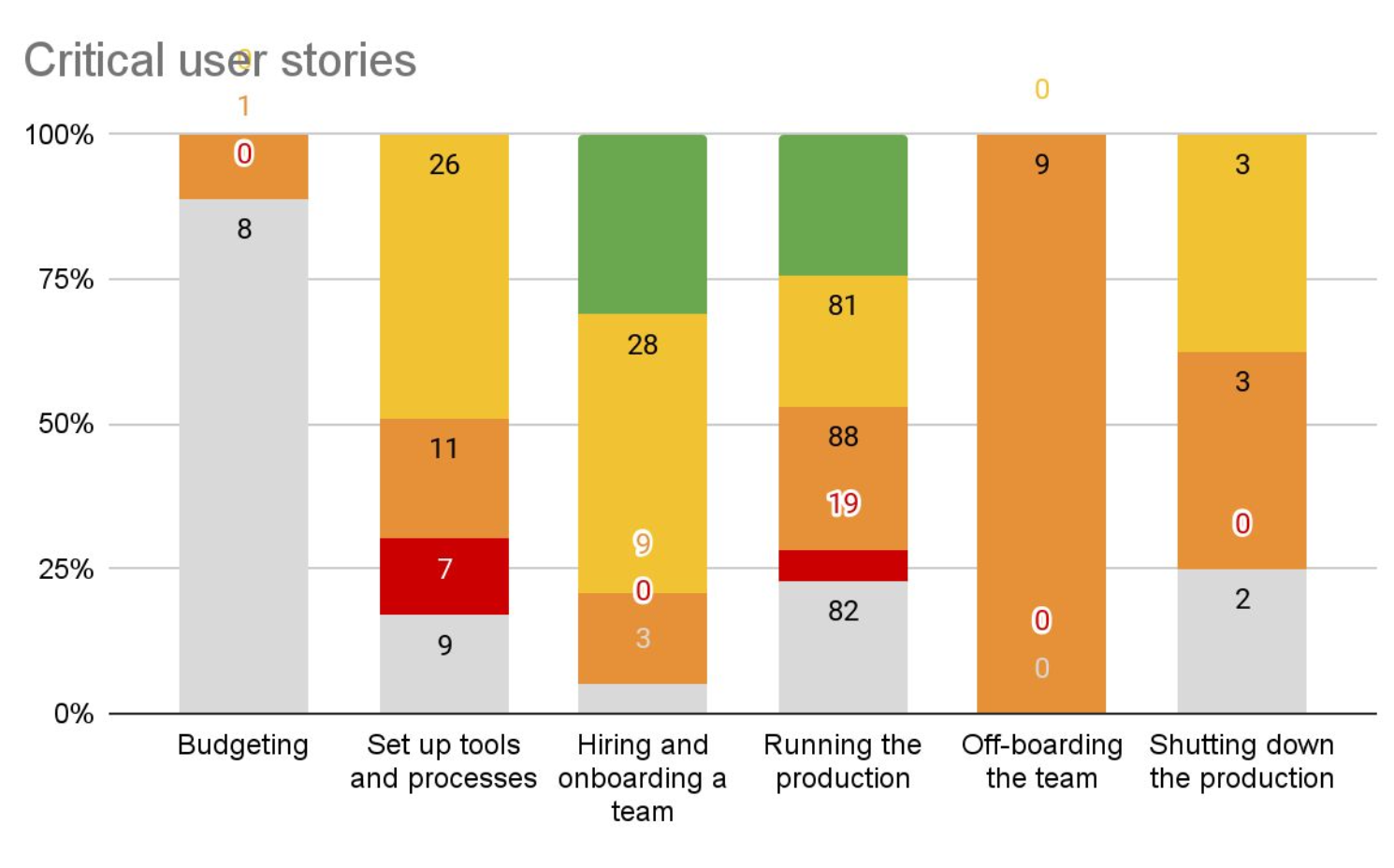
I conducted an assessment to measure unmet user needs and was able to clearly communicate the gaps to all stakeholders.
I collaborated with the product managers to divide the user stories we had mapped into two categories; critical stories were necessary to complete the task and the others were enhancements.
We used the list of critical stories to plan an initial scope of work, quickly following up with the most impactful enhancements.
This approach maximised the ROI of our research by using the same distilled user needs to plan our scope and assess the competition. This repeatable process was used to communicate our progress over time.
I was able to use the same framework of user needs to conduct detailed competitor analysis - reviewing demo videos, sales websites and customer interviews. This enabled us to clearly define how and when our product would be differentiated from the competition.
Strategy
What we learned
❌ Our customers were choosing the competition because of their timesheets product(s); even though they still required a lot of manual effort to reconcile.
❌ Delays to payroll can cost production teams millions of pounds; if one person leaves because of issues with their pay, the whole production can grind to a halt.
❌ There’s only a few days to gather this information, calculate everyone’s pay and pay them; the biggest delays are caused by
Chasing people to submit their timesheets
Getting them all approved
There was an opportunity to win market share by maximising customer satisfaction and differentiating ourselves from the competition.
My hypothesis was that we could do this by optimising our product for the following leading indicators:
Minimising the time it takes for crew to complete their timesheet (currently ~1h)
Minimising the time it takes for production managers to approve all timesheets (currently ~48h)
Solution design
12
Months
4
Milestones of work
~2000
Screens and modal variants
100h
User testing and validation
4.5 of 5
Indicated C-Sat score
Speeding up submissions
-
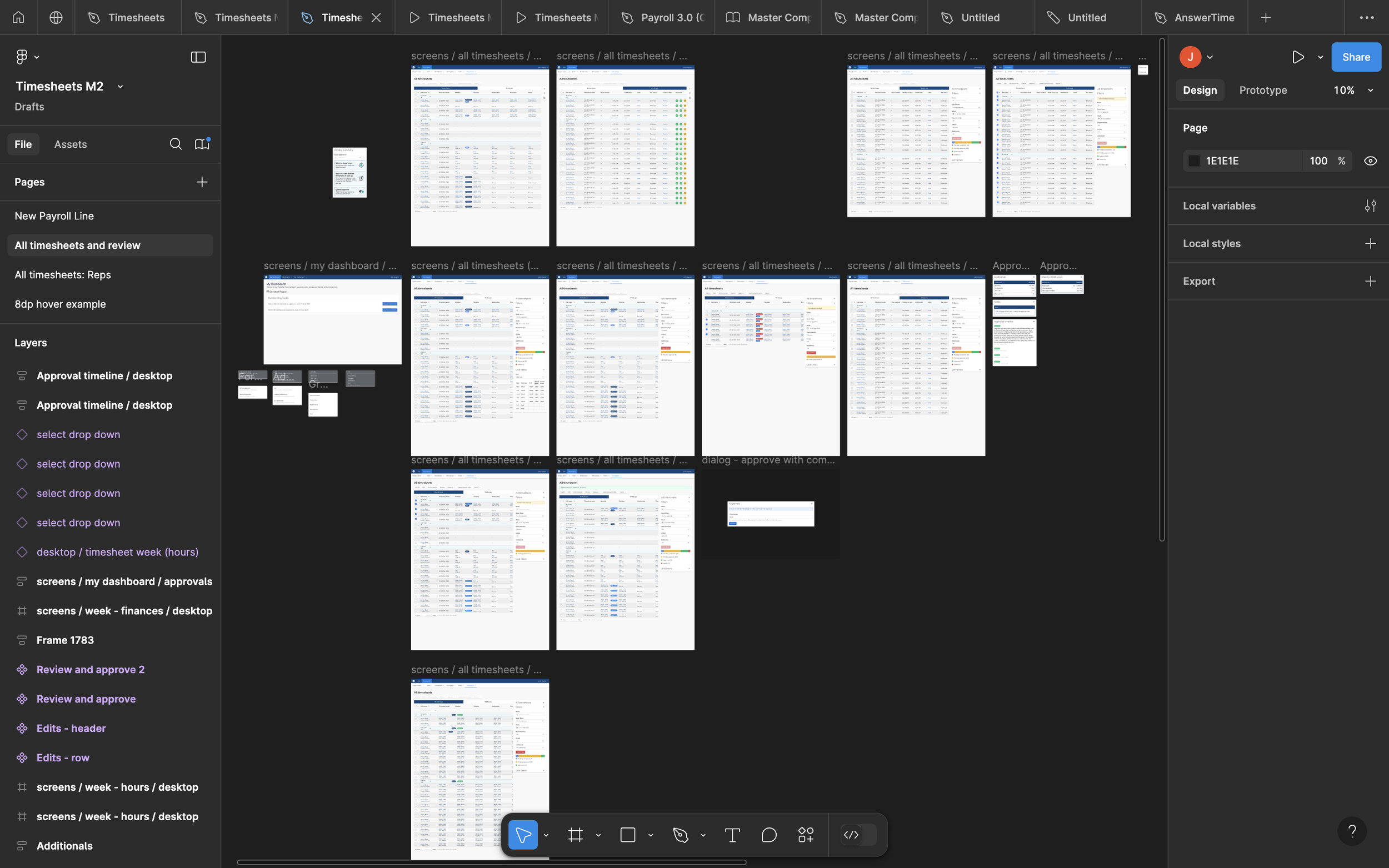
Centralised daily schedule
Old way: Crew have to manually complete all of their worked hours, even though they usually reflect the daily schedule.
New way: Pre-populate the timesheet with the hours you’re contracted to work, in line with the daily schedule.
-
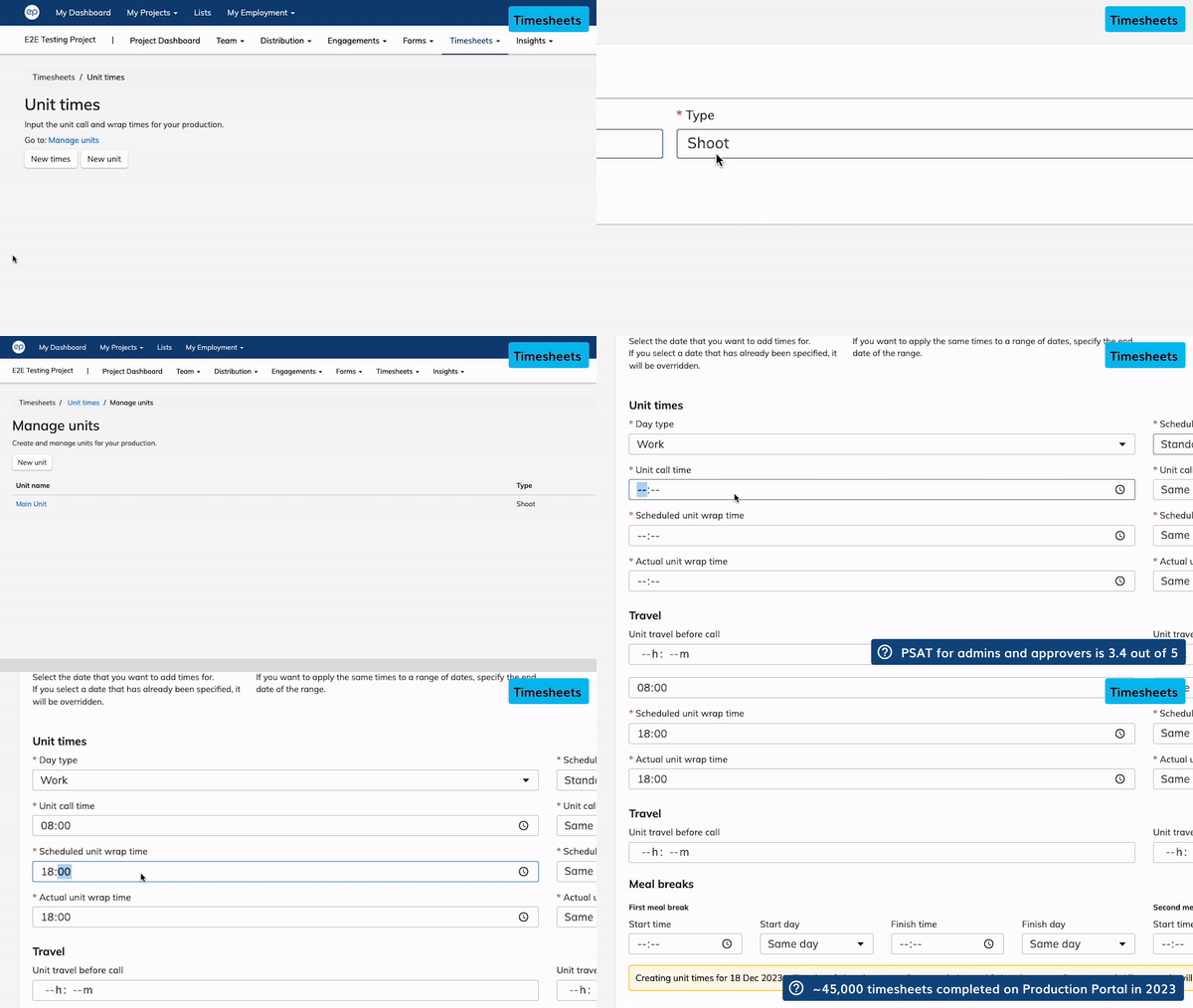
Calculate their gross pay
Old way: Timesheets are input-only, leaving crew to interpret the complex overtime rules on their own - often leading to invoices being revised multiple times, delaying payment.
New way: Gross payments are calculated as timesheets are completed, meaning crew can invoice for the correct amount first time.
-
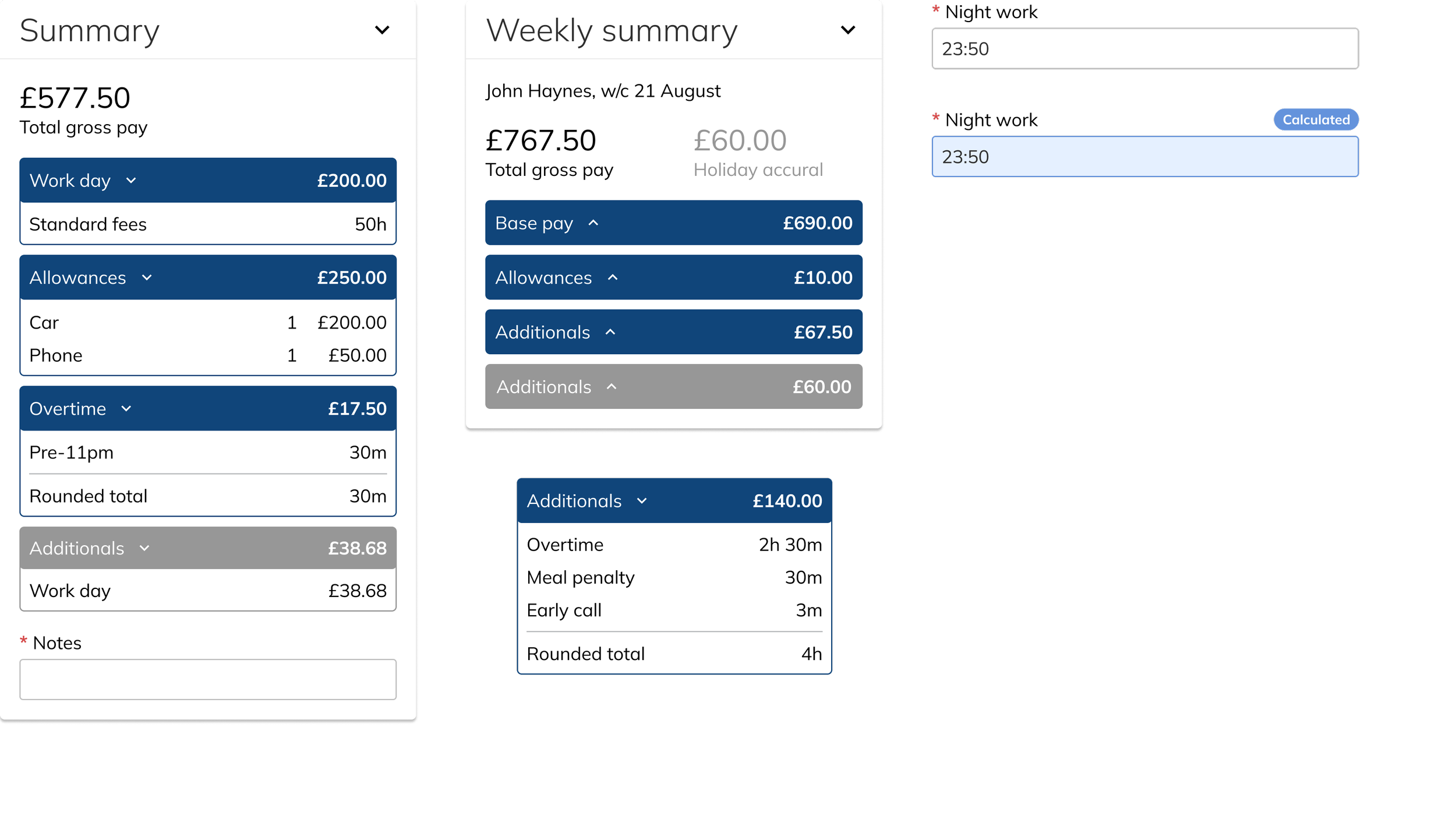
All payments in one place
Old way: Timesheets were just one of a number of forms that needed to be submitted in order to get paid.
New way: The timesheet includes mileage, expenses and petty cash claims, all submitted in one go.
Speeding up approvals
-
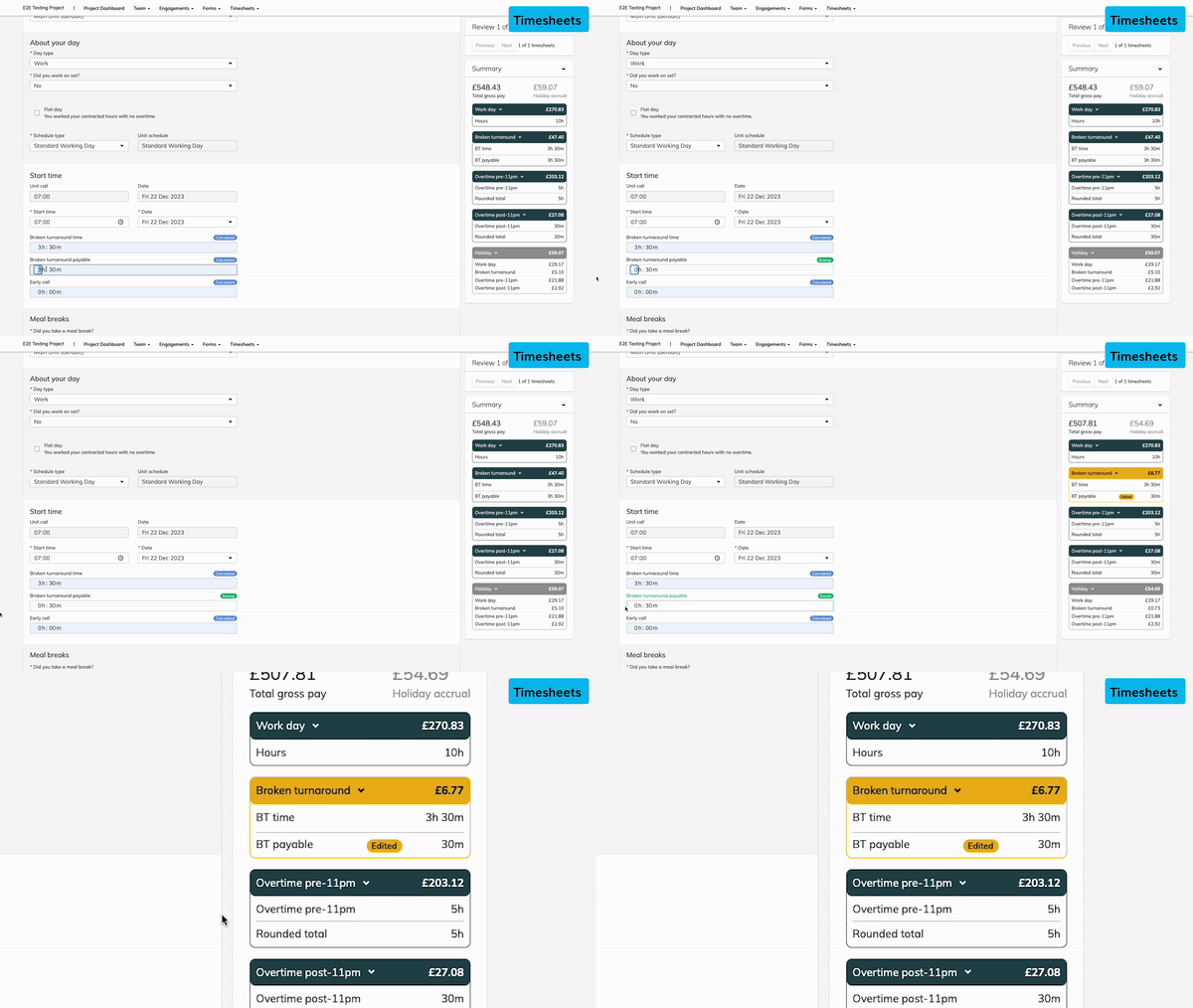
Highlight edited values
Old way: Timesheet approvers have no way to differentiate between controversial timesheets (that have worked the scheduled hours) or those claiming unexpected overtime.
New way: All edits are highlighted on the timesheet, enabling approvers to quickly identify timesheets that require their attention.
-
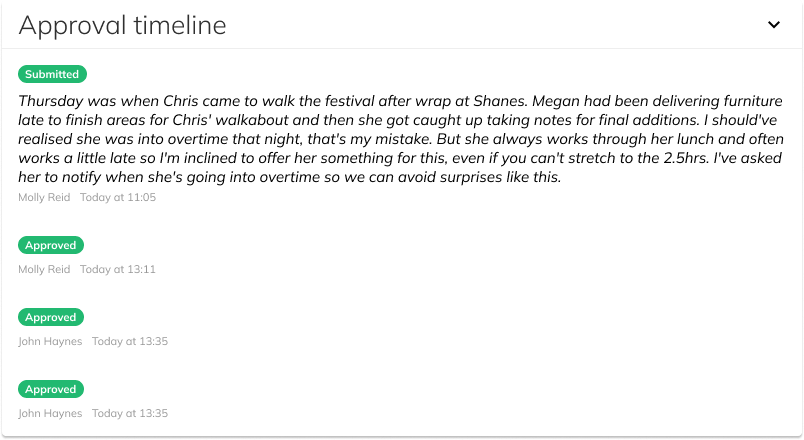
Show the history of changes
Old way: Timesheet approvers use email or WhatsApp to communicate changes they’re making, often leading to stress and confusion.
New way: Each timesheet includes a time-series log of all changes, to show when & who made changes to it.
-
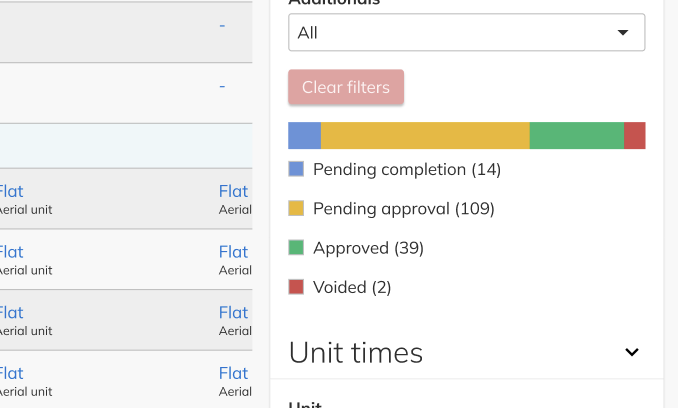
What do I need to approve?
Old way: Approvers worked through each timesheet one at a time, like a stack of paper, until there’s nothing left to do.
New way: One place to view all the timesheets that can be filtered to drill-down by department, contract type or completion status.
-
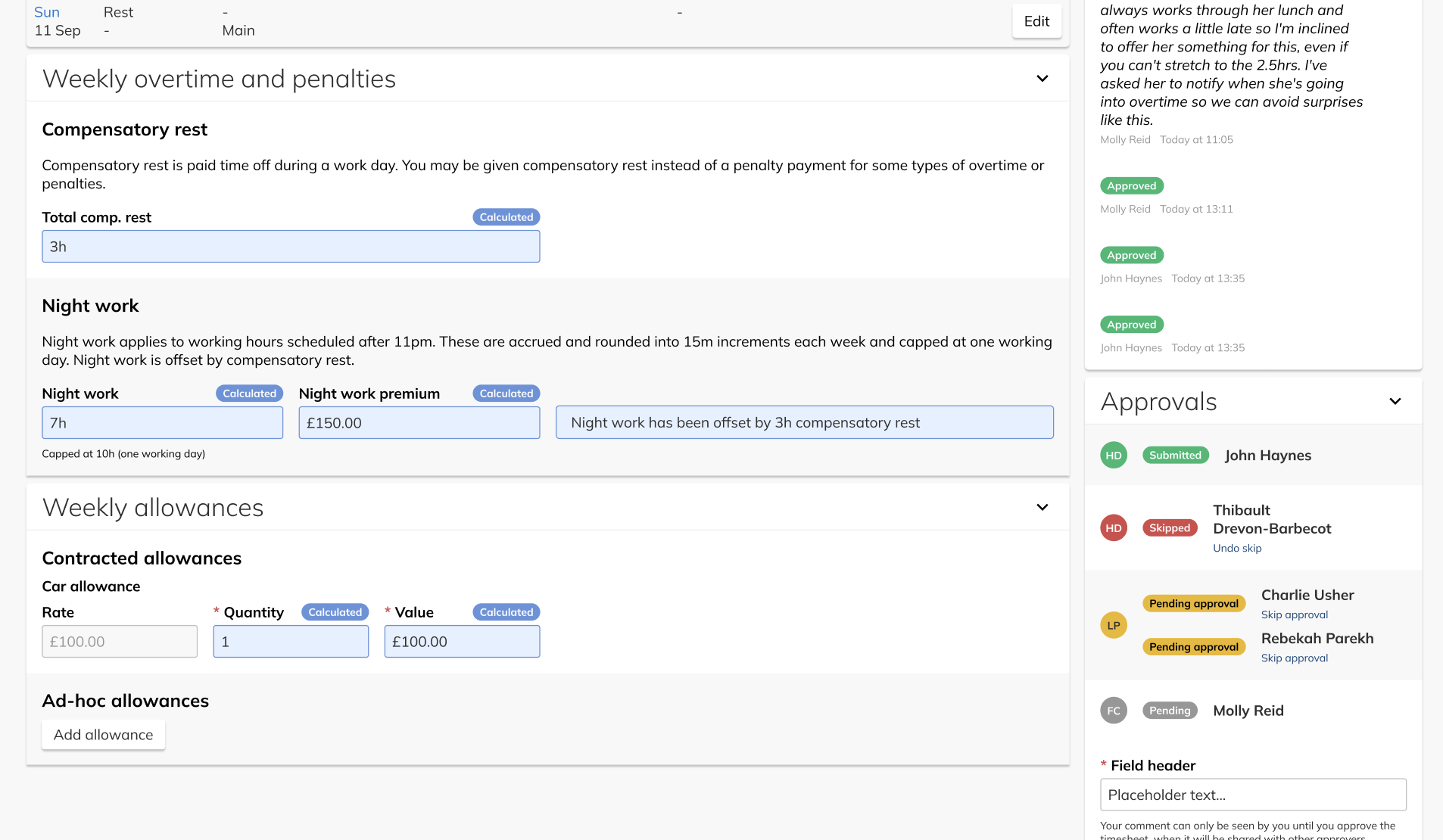
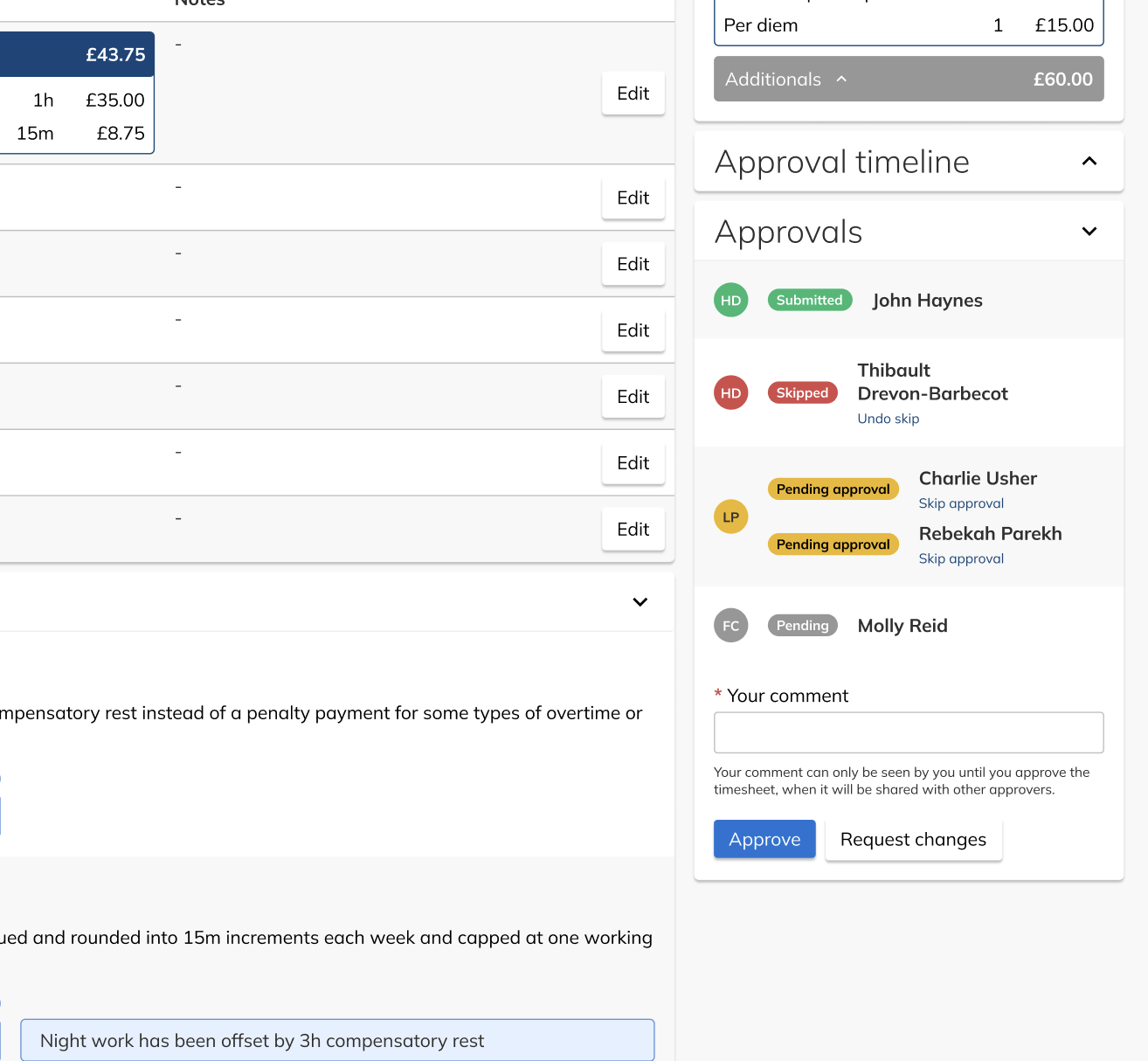
Who has approved this timesheet?
Old way: Approvers have no visibility of the rest of the approval chain, so its unclear whether there are any bottlenecks until it’s too late.
New way: The approval chain for each timesheet is visible, along with a colour-coded status to show pending and completed actions.
-
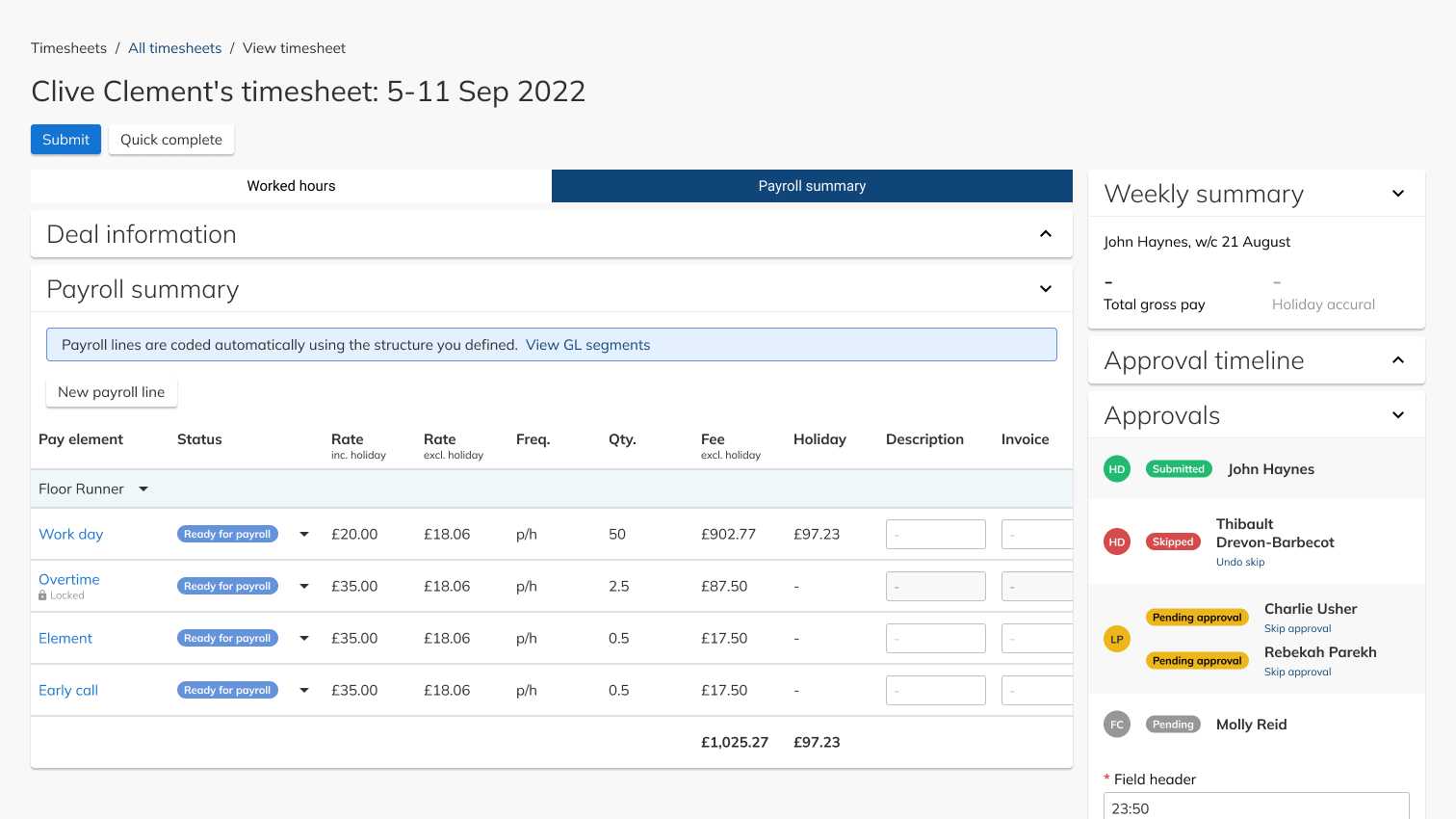
Summarise finances for accountants
Old way: Accountants manage all information relating to timesheets in a separate spreadsheet, taking significant manual effort to cross-reference payment information.
New way: Accountants and approvers have permission to switch to a financial summary of a timesheet, with payments accurate to eight decimal places.
-
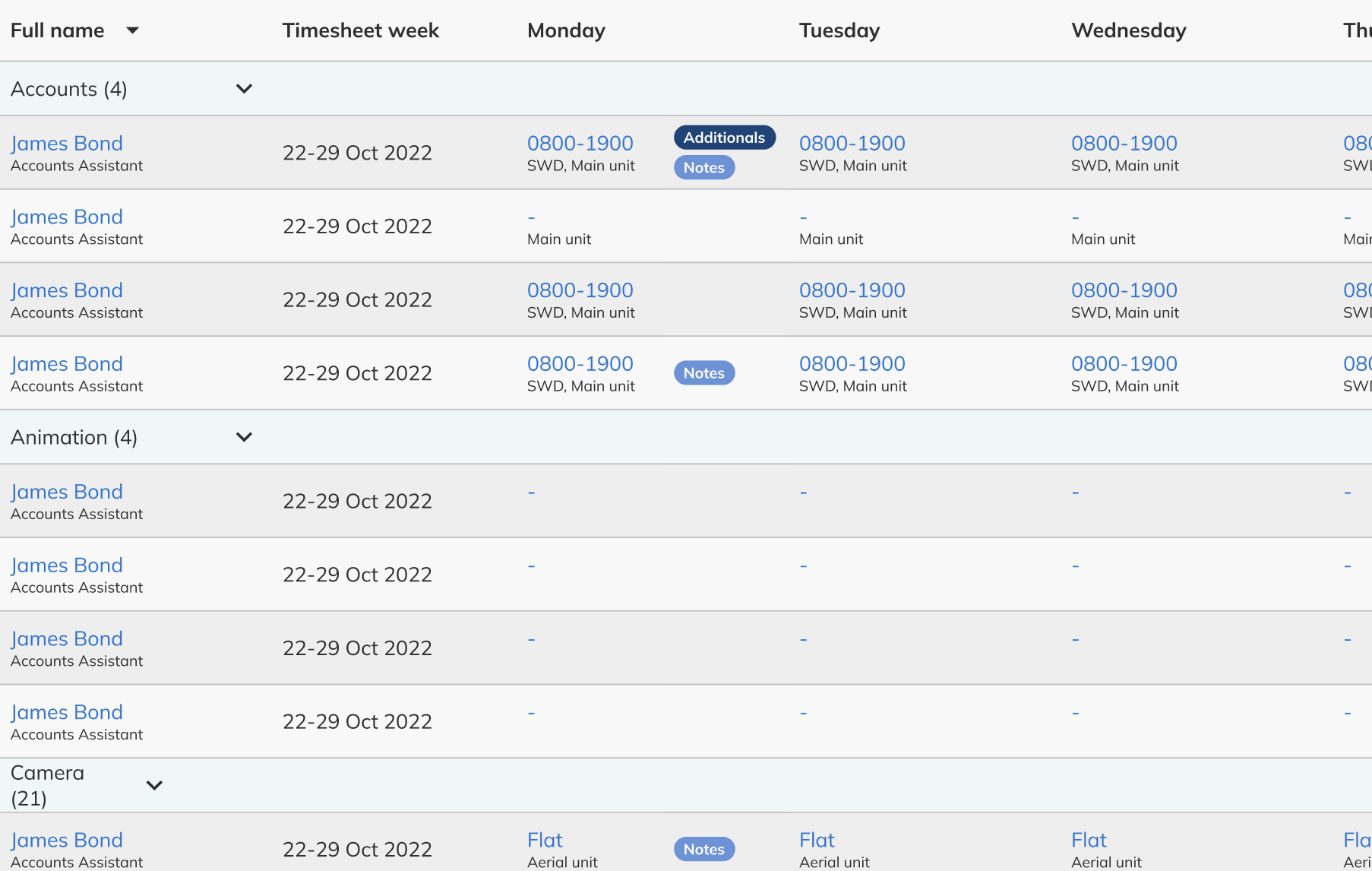
Is anyone claiming unusual overtime?
Old way: View each timesheet individually, with no way to quickly compare timesheets from the same department.
New way: A single summarised view to view workers across all departments, enabling approvers to view and compare the hours worked.
Results
Maximise the market share
Market share increased to 7% (+4%) with a 93% customer retention rate
Minimise the time taken to complete a timesheet (without negatively impacting accuracy)
Reduced from ~1h to 5m
Minimise the time taken to approve all timesheets weekly (without negatively impacting accuracy)
Reduced from ~48h to 24h